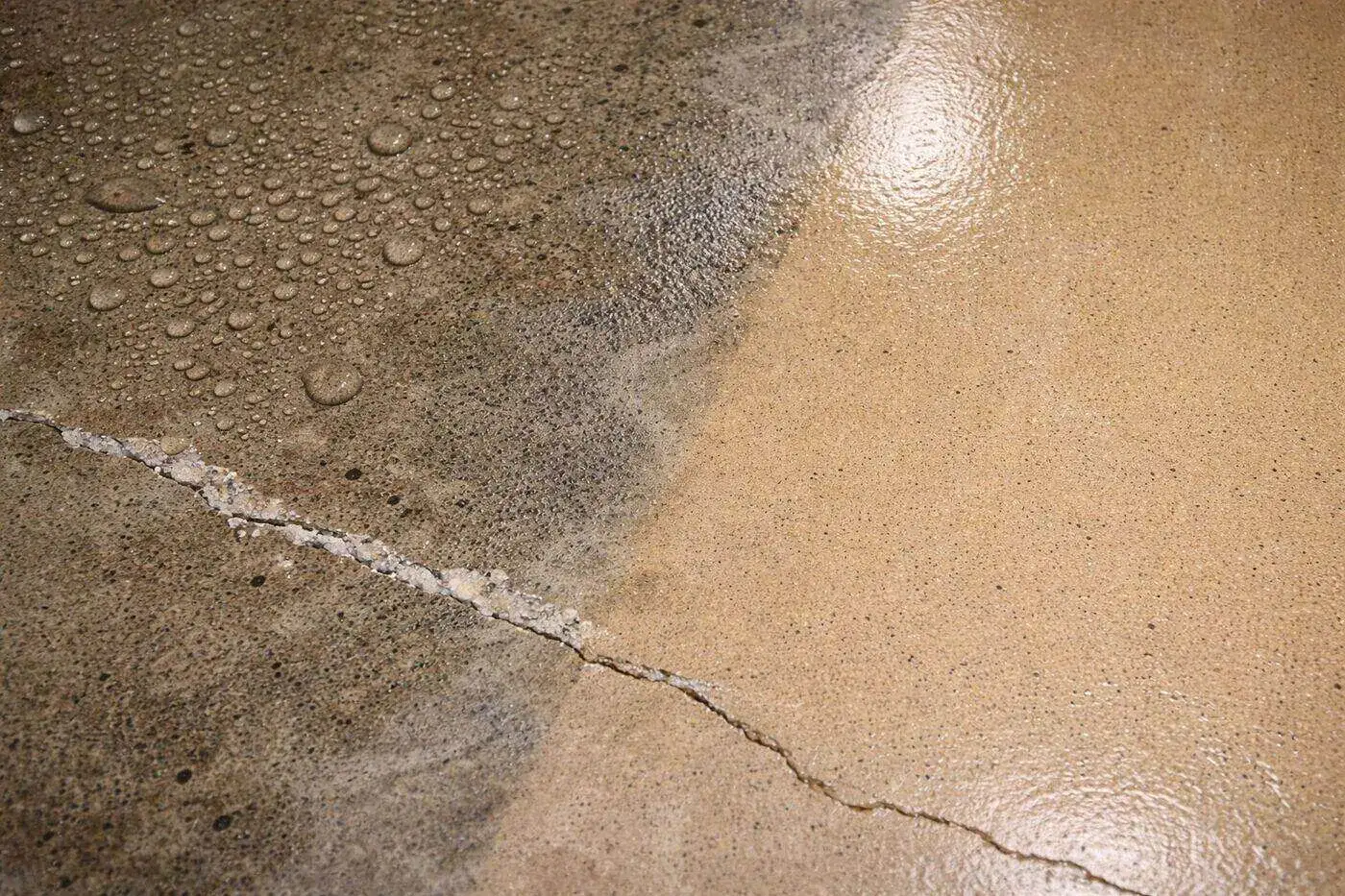
There is no honest one-size price for an epoxy floor in metro Atlanta. Every floor is priced after a free on-site measurement, because the number depends on five things: the size of the space, the condition of the slab, the moisture coming up through it, the system and finish you choose, and the prep the concrete needs before anything goes down.
Pricing here behaves differently than the national averages you will find online, and there is a local reason for it. metro Atlanta slabs sit on red clay that holds moisture, bake under humid subtropical sun, and take winter road brine tracked in off the street — conditions that quietly decide whether a coating lasts a decade or lifts in a single wet spell. All of that lives inside the number a contractor eventually quotes you, and almost none of it gets explained on the phone.
This guide does the explaining. Below you will find how each finish moves the price in the metro Atlanta market, what decides where a two-car garage lands, and — most importantly — the slab-moisture test and mitigation step that separates an honest metro Atlanta quote from a cheap one that fails. Every Precision Epoxy Atlanta price comes from a free on-site estimate, so every homeowner gets an exact number for their own slab, not a guess. Coating a garage in Peachtree Corners, refinishing a condo floor in Decatur, or putting down a commercial floor in Sandy Springs — call (404) 974-2647 for an exact price on your slab, or read on first.
How Each Finish Moves the Price in metro Atlanta
"Epoxy" is shorthand for a family of coating systems, not a single product, and which one you choose moves your price more than anything else on the estimate. It also dictates how the floor wears, how it reads underfoot, and how many metro Atlanta summers it survives. Four systems cover almost every home and small-commercial job we install across metro Atlanta. Here is how they compare, before the prep this climate forces is added in.
| Finish | Where It Sits on Price | Best For |
|---|---|---|
| Solid Color | Lowest of the four | Utility garages, storage, budget-conscious projects |
| Flake / Chip | Middle | The most popular garage floor; hides marks, adds grip |
| Metallic | Upper end | Showrooms, interiors, high-end designer floors |
| Quartz | Upper end | Maximum durability and slip resistance |
Solid Color Epoxy
This is the floor that gets a slab from bare gray concrete to a sealed, glossy, single-color surface you can hose off and forget. For a workshop bay, a storage room, or a rental-property garage where the job is function rather than show, it is the sensible pick. The catch in metro Atlanta is that "basic" never means "skip the prep." The slab still gets a full diamond grind, and on the many homes built over clay-held slab moisture it still needs a moisture primer underneath — which is why a metro Atlanta solid-color floor starts a notch above the bargain figures you will see quoted for dry inland states.
Flake / Chip Epoxy
Flake is the floor most Sandy Springs and Atlanta garages end up with, and for good reason. Vinyl chips are cast into the wet base coat to build a textured, multi-tone surface that camouflages hot-tire marks, hides the hairline cracking common in slabs that have flexed through freeze-thaw ground movement, and gives bare feet real traction when a rained-on car or a hosed-down bike drips across it. The blends run from soft metro Atlanta neutrals to high-contrast looks. We almost always cap a flake floor with a polyaspartic topcoat here — it is what makes the system shrug off humidity and Georgia sun — and that pairing sits at the upper end of what a flake floor costs. In this climate the upgrade is not optional dressing; it is the part that lasts.
Metallic Epoxy
Metallic is the showpiece. Reflective pigments are suspended in clear resin and moved by hand as it cures to produce flowing, marbled, three-dimensional patterns — no two pours alike. Around here it shows up in finished-basement interiors, home gyms, boutique storefronts in Johns Creek, and the kind of garage a car enthusiast treats as a second living room. The price tracks design complexity: a single-pigment marble effect costs less than a multi-color, multi-layer pour. Most of that spread is the installer's hand skill, which is the one thing you cannot fake on a metallic floor.
Quartz Epoxy
Quartz is built for abuse. Colored quartz granules are broadcast into the resin to create a thicker, harder, aggressively slip-resistant surface that handles heavy rolling loads, dropped tools, and daily wash-downs. You will find it in commercial kitchens, medical and dental suites, locker rooms, and food-prep areas, and it doubles as a premium residential floor anywhere safety underfoot is the priority — a pool bath or a screened porch conversion, for instance. Because the spec is tailored to the room's traffic and chemical exposure, commercial quartz is quoted after a walkthrough rather than off a price list.
Not Sure Which Finish Fits Your Space?
Tell us about your slab and your goals. We will recommend the right system and give you a real number, free.
What Sets the Price of a Two-Car Garage in metro Atlanta
The two-car garage is the project we are asked to price more than any other in metro Atlanta, which makes it the cleanest example of how a quote comes together. Around here those bays generally measure 400 to 500 square feet, and a single-car bay roughly 240 to 300. Done right — a quality flake system on a properly prepped slab, with the polyaspartic wear layer we recommend in this climate — the price covers far more than coating: diamond-grinding the concrete, routing and filling cracks and any spalling, the pigmented base coat, the flake broadcast, and the protective topcoat that actually defends the floor against metro Atlanta humidity and sun. How much of that work your slab needs is exactly what the free on-site estimate measures.
Choose a metallic floor for that same two-car space and the total moves up, because metallic eats more material and far more skilled labor per square foot. Drop to a plain solid-color system and the total comes in below a flake floor, slab condition permitting. Commercial floors play by their own rules and are quoted once the system, the square footage, and the room's traffic are known.
| What Moves the Price | What We Check at the Free Estimate |
|---|---|
| Size of the space | Measured square footage, from a 240–300 sq ft single bay to a 400–500 sq ft two-car garage and up |
| Slab condition | Cracks, spalling, and any old coating or sealer that has to come off |
| Moisture | The free slab-moisture reading, and whether a mitigation primer is needed |
| System and finish | Solid color, flake, metallic, or quartz, and the polyaspartic topcoat |
| Prep and access | Diamond grinding, crack and joint repair, and how easy the space is to work in |
See your metro Atlanta price in 60 seconds.
Pick your garage size, finish, and color, then see a real preview and your price range before you ever pick up the phone.
Two variables move a metro Atlanta quote more than any other: the condition of your slab, and whether the concrete needs moisture mitigation. In metro Atlanta the second one shows up far more often than the national charts would lead you to expect, so it earns the top of the next section.
The metro Atlanta Cost Drivers Behind Your Quote
Those national price calculators assume an average slab in a dry, temperate climate. A metro Atlanta slab is the opposite of that on almost every axis — it sits on moisture-holding red clay, bakes under Georgia sun, and breathes road brine. Four conditions push the price of a floor that actually lasts above the inland baseline, and the first one is the line item most low-bid quotes quietly leave off.
The Slab-Moisture Test and Mitigation Line Item
Start here, because this is the single line that most often separates an honest metro Atlanta estimate from a cheap one. metro Atlanta's red clay holds moisture against the slab, and a large share of slabs — especially ground-level Sandy Springs and Brookhaven homes, and anything that has taken on water in a storm — drive enough moisture vapor up through the concrete to lift a coating from below months after it cures. The only way to know is to measure it. Before we quote, we run a slab-moisture test (a calcium-chloride or relative-humidity probe reading), and at Precision Epoxy Atlanta that test is free — a step many companies either skip or bill for. If the reading comes back above the safe threshold, a moisture-mitigation primer becomes mandatory, and it is added to the job as its own line. It is not an upsell. It is the difference between a floor that holds and one that bubbles and delaminates — the number-one cause of premature epoxy failure in Georgia.
A Humidity-Rated Polyaspartic Topcoat
metro Atlanta humidity hangs around 75 percent for much of the year. Conventional slow-cure epoxy can blush, cloud, or refuse to cure cleanly in that air, which is why we top our flake systems with polyaspartic or polyurea instead. They kick faster, tolerate the moisture in the air, and resist yellowing. Expect that topcoat to cost more than a plain epoxy finish on the same flake spec — the premium that turns a coating into a system built for metro Atlanta rather than one borrowed from a drier state.
UV Stability for Georgia Sun
Humid subtropical sun ambers and chalks any topcoat that is not UV-stable, and it works fast — on a garage floor left exposed with the bay door up, on a sun-washed screened porch, on any interior with western glass. A UV-stable topcoat should be standard on every metro Atlanta floor, which a polyaspartic or polyurea system delivers as a matter of course. It nudges the baseline spec above what a cooler, cloudier market could get away with, and it is the reason a floor here still looks new after a few summers instead of fading to a tired yellow.
Georgia Road Brine and Metro Atlanta Exposure
From Sandy Springs out to Decatur, Alpharetta, and Johns Creek, winter road brine chews at coatings along edges and open bay openings over time. On a closed, conditioned garage it is a minor factor; on an open-bay shop, a patio, a warehouse, or a walk-out basement it is a real one, and the recommendation shifts toward a thicker, more chemically resistant system with a UV-stable topcoat. If your slab takes winter road brine, expect that to register in the quote.
Put plainly: the clay-held slab moisture, the humidity, the heat, the UV, and the salt mean the right floor in metro Atlanta is rarely the cheapest one on paper. Those drivers raise the spec, and the entry price along with it — but the spec is exactly what buys you years instead of months. For the full breakdown of how moisture wrecks a coating and the test that catches it first, read our companion guide on why epoxy floors fail in metro Atlanta and the moisture test that prevents it.
Matching the Finish to How You Live on It
The right finish is less about budget and more about how the room gets used — and in metro Atlanta, how exposed it is to heat, moisture, and salt. A quick way to place yourself:
- Function over looks: Solid color seals a workshop, storage bay, or rental garage in a clean, sweep-and-go surface without paying for decoration.
- The everyday metro Atlanta garage: Flake is the default for a reason — it hides marks and hairline cracks, grips wet feet, and, capped with a polyaspartic topcoat, holds up to our humidity and sun better than anything in its price class.
- A floor you want people to notice: Metallic turns a slab into a centerpiece for a creek-side-home interior, gym, or showroom.
- Hard use and wet-floor safety: Quartz is the toughest, grippiest option going — the standard for commercial kitchens, clinics, and pool-area conversions.
If you are coating a typical garage and want one recommendation, it is a full flake broadcast under a polyaspartic topcoat. It hits the balance of looks, toughness, and — the part that matters most in metro Atlanta — the humidity and UV defense this climate quietly demands. And if you landed here after searching for “garage floor coating near me” around Atlanta, that flake-plus-polyaspartic build is exactly the system we install day in and day out across metro Atlanta.
How to Read a metro Atlanta Quote (and Spot a Bad One)
A price per square foot tells you nothing until you know what work sits behind it. When you line up estimates side by side, make sure each one names the full scope — otherwise you are comparing a finished floor to a coat of paint. Five things should appear in writing:
- A slab-moisture test, done before the quote. In our climate this is step one. If a company never mentions testing your concrete for vapor transmission, that is the tell — ask directly, and be wary if the answer is vague.
- Mechanical prep, spelled out. The slab should be diamond-ground, not splashed with acid etch. The quote should state the prep method, not just "surface preparation."
- Crack and spall repair. Cracks get routed and filled before any coating goes down. Confirm it is in the scope.
- A complete system, not one thin coat. Base coat, decorative layer, and a UV-stable polyaspartic or polyurethane topcoat. If it is a single coat, it is not a system and it will not last here.
- One bottom-line total. Compare the all-in project price, not the per-foot teaser, because prep and topcoat are exactly where a low bid hides its corner-cutting.
When one estimate comes in dramatically under the rest, assume something was left out, and go looking for it. The usual suspects are no moisture test, no real grinding, watered-down consumer-grade product, and no protective topcoat — the four shortcuts that save you money today and cost you the entire floor inside a year or two. A properly built epoxy floor should give a metro Atlanta home a solid decade or two of service, so the prep that drives the price is also what earns it back.
Frequently Asked Questions
How much does epoxy flooring cost in metro Atlanta?
Every floor is priced after a free on-site measurement, because the price depends on the size of the space, the condition of the slab (cracks, old coatings, moisture), the system and finish you choose, and the prep the concrete needs. Solid color is the simplest system, flake with a polyaspartic topcoat is the most common garage floor, and metallic and quartz sit at the upper end. Call (404) 974-2647 or request a free estimate for an exact price, with no obligation.
Why does epoxy cost more in metro Atlanta than the national average?
metro Atlanta's clay-held slab moisture, summer humidity, Georgia sun, and winter road brine all raise the minimum spec. Many slabs here need a moisture-mitigation primer under a humidity-rated, UV-stable polyaspartic topcoat. That prep is precisely what keeps the floor from peeling, so the entry price sits above a dry inland market.
How much does a 2-car garage epoxy floor cost in metro Atlanta?
A typical metro Atlanta two-car garage is 400 to 500 square feet. Its price depends on that measured size, the slab's condition, the moisture reading, and the system you choose: a quality flake system covers diamond-grind prep, crack and spall repair, the base coat, and the flake broadcast, and a protective polyaspartic topcoat or a metallic finish adds to it. We measure and test the slab for free and give you an exact price, with no obligation.
Does my slab need a moisture test before epoxy?
In metro Atlanta, usually yes. The clay-held slab moisture, and any slab that took on water during a storm, can push enough vapor through the concrete to lift a coating from below. We run a free slab-moisture test before quoting; if the reading is over the safe threshold, a moisture-mitigation primer is required and shows on your quote.
Which epoxy finish is the best value for a metro Atlanta garage?
For most metro Atlanta garages, a full flake broadcast under a polyaspartic topcoat is the sweet spot. It hides marks and hairline cracks, grips wet feet, looks finished, and carries the humidity and UV protection this metro Atlanta climate requires.
How long will a professionally installed epoxy floor last in metro Atlanta?
With diamond-grind prep, moisture mitigation where the test calls for it, and a UV-stable topcoat, expect roughly 10 to 20 years in a home and 5 to 10 in a commercial space. The early failures people hear about in Georgia come from skipped prep and missed moisture testing, not the coating technology itself.
Get Your Personalized metro Atlanta Epoxy Quote
This guide gets you most of the way, but the only honest number for your floor comes from standing on your slab. At Precision Epoxy Atlanta, every estimate begins with a real look at your concrete, the free moisture test, and a straight conversation about which finish actually fits your space, your exposure, and your budget. No pressure, no bait-and-switch, just a clear price and a system engineered for metro Atlanta.
Ready to start? Call us at (404) 974-2647 or request a free quote online. We serve Sandy Springs, Brookhaven, Decatur, Dunwoody, Johns Creek, Alpharetta, Peachtree Corners, Roswell, Marietta, and the surrounding communities across metro Atlanta.